Heat pumps
ASHP and heat pump survey capture
The survey package supports key heat pump evidence: external siting, pipe route, cylinder area, electrical notes, access constraints, photos, and the details needed by design teams.

Full UK infrastructure, expert surveyors, guided capture, AI-assisted QC, clear PDF v2 reports and portal handover for installer teams.
Software is only one part of it. The real value is the full Vertex survey system: UK coverage, people, process, evidence, report pack, portal and quality control working together.
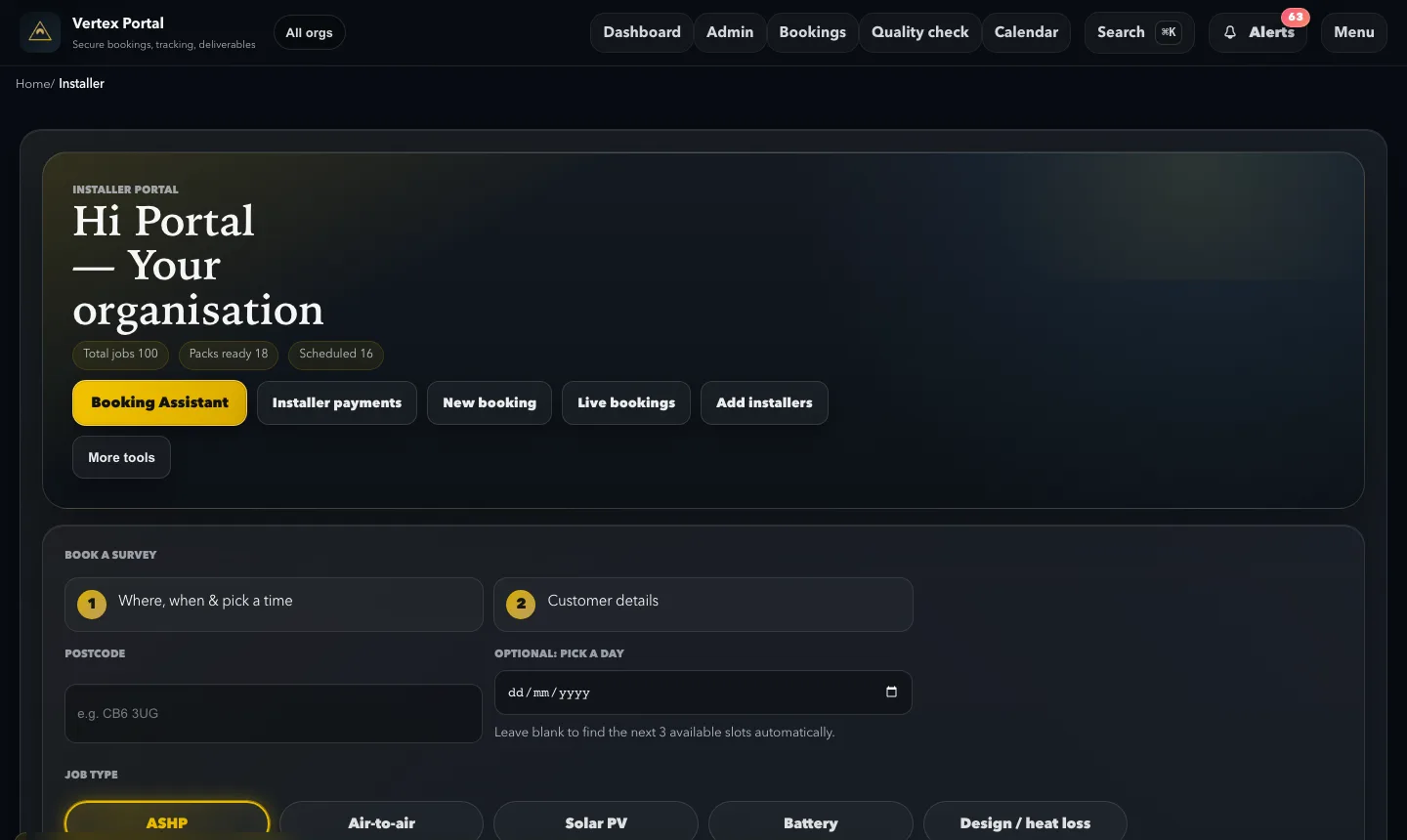

Renewable surveys are easy to weaken with one missed photo, unclear note, or buried constraint. Vertex combines UK survey coverage, field surveyors, guided capture, report review, and portal handover so the evidence route stays consistent from booking through to final PDF.
The survey package supports key heat pump evidence: external siting, pipe route, cylinder area, electrical notes, access constraints, photos, and the details needed by design teams.
Survey routes can guide capture around roof access, inverter location, consumer unit evidence, cable route, battery location, and site constraints.
For heat loss work, the process supports room information, photos, emitter notes, insulation context, and the evidence needed for a clearer design check.
Vertex is built for installer teams that need renewable survey capacity beyond one region. Coverage, booking, report delivery, and account visibility are handled as one operating system.
Vertex does not sell or install heat pumps, solar panels, or batteries. The focus is survey evidence that helps installers quote, design, and deliver with fewer avoidable gaps.
The output is not loose notes. Installer teams receive a clear report pack backed by portal status, review checks, and the evidence needed for the next team.
A renewable survey provider has to do more than attend site. The work has to be bookable, repeatable, checked, traceable, and useful to the teams that quote, design, install, and support the job afterwards.
Survey routes address the questions that slow heat pump jobs down. They show where equipment can go, what the route looks like, which evidence is missing and what the design team needs before the quote hardens.
Solar and battery survey work has to make roof and electrical assumptions visible. Vertex packages roof evidence, access notes, consumer unit context, inverter position, cable routes, and battery location detail for the next stage.
Heat loss work depends on measured inputs and visible assumptions. Vertex keeps room data, photos, emitter notes, insulation context, and report outputs clear enough for review.
AI is useful when it supports the survey standard rather than pretending to replace experience. It helps the team notice weak notes, missing evidence, and incomplete sections early enough to fix them.
AI-assisted prompts help the surveyor turn site observations into notes that are easier for the reviewer and installer team to understand.
Auto-QC can support checks for missing photos, incomplete fields, unclear constraints, and areas that need manual review before issue.
AI does not approve designs, certify compliance, or decide that a report is ready. People review exceptions, limitations, and unclear evidence before issue.
Configured AI providers may process the information needed for a feature. Email addresses and phone numbers are redacted where the task does not require them, and AI activity is logged for review.
The privacy policy explains the current AI-provider, redaction, and booking-intake position in more detail.
Once the survey is complete and checked, the report pack is delivered through the Vertex Portal. The booking, status, downloads, and account access stay together so teams are not chasing old email chains.