People
Expert surveyors with a repeatable route
The capture process is designed around the evidence installers ask for after the visit: access, electrics, plant, roof, routing, constraints, photos, notes, and measurements.

Full UK survey infrastructure for installers: expert surveyors, guided capture, AI-assisted QC, PDF v2 reports and portal delivery.
One clear portal record, one consistent report structure, and the same standard whether the job is ASHP, GSHP, solar PV, solar design, battery storage, EPC evidence or heat loss.
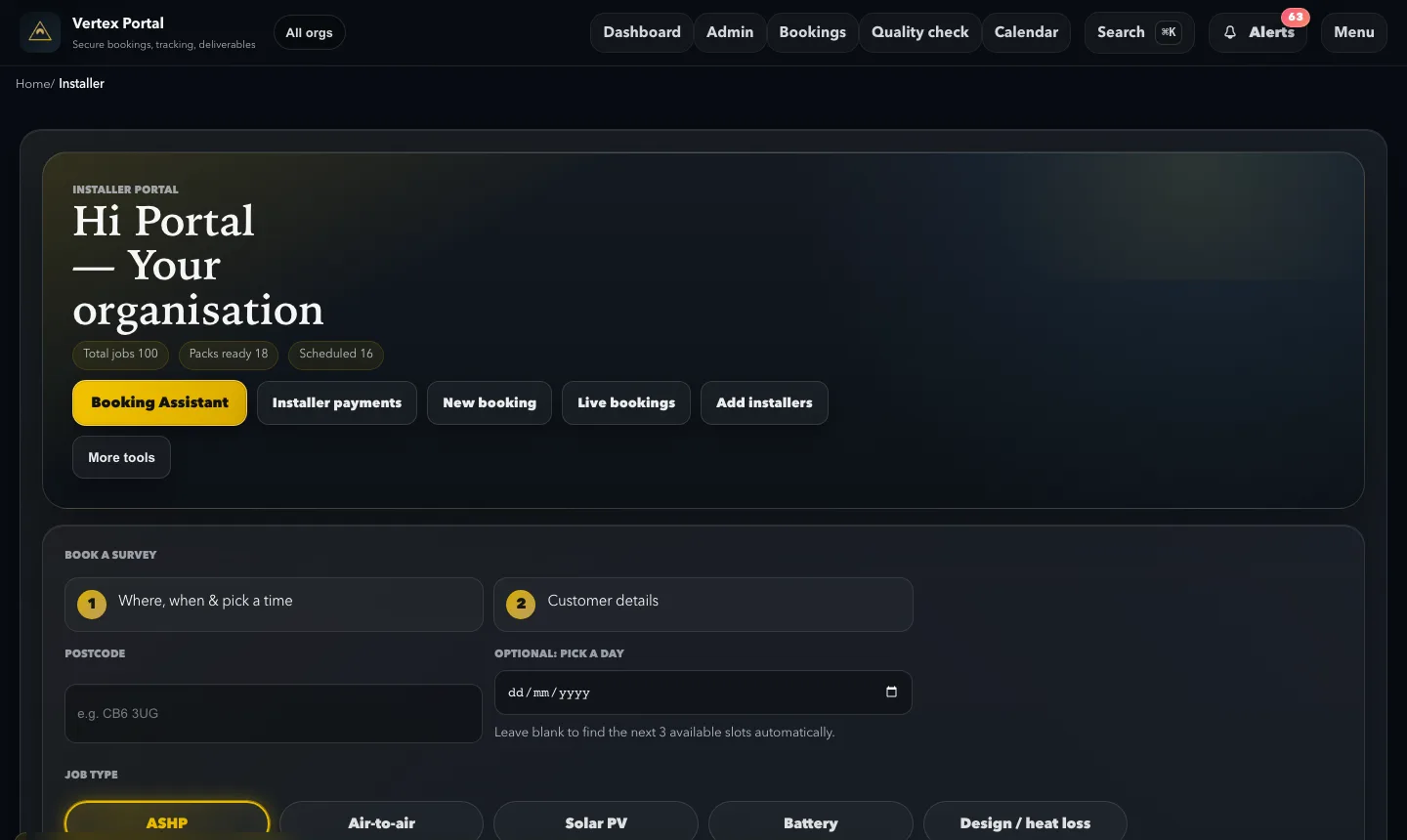
Installer teams need more than a form on a phone. Vertex brings together trained surveyors, full UK coverage, guided capture, completion checks, report production, portal handover, and a consistent PDF structure your office, design, and install teams can use.
The capture process is designed around the evidence installers ask for after the visit: access, electrics, plant, roof, routing, constraints, photos, notes, and measurements.
AI-assisted QC supports the review process by helping flag missing photos, incomplete notes, and sections that need attention while the job is still fresh.
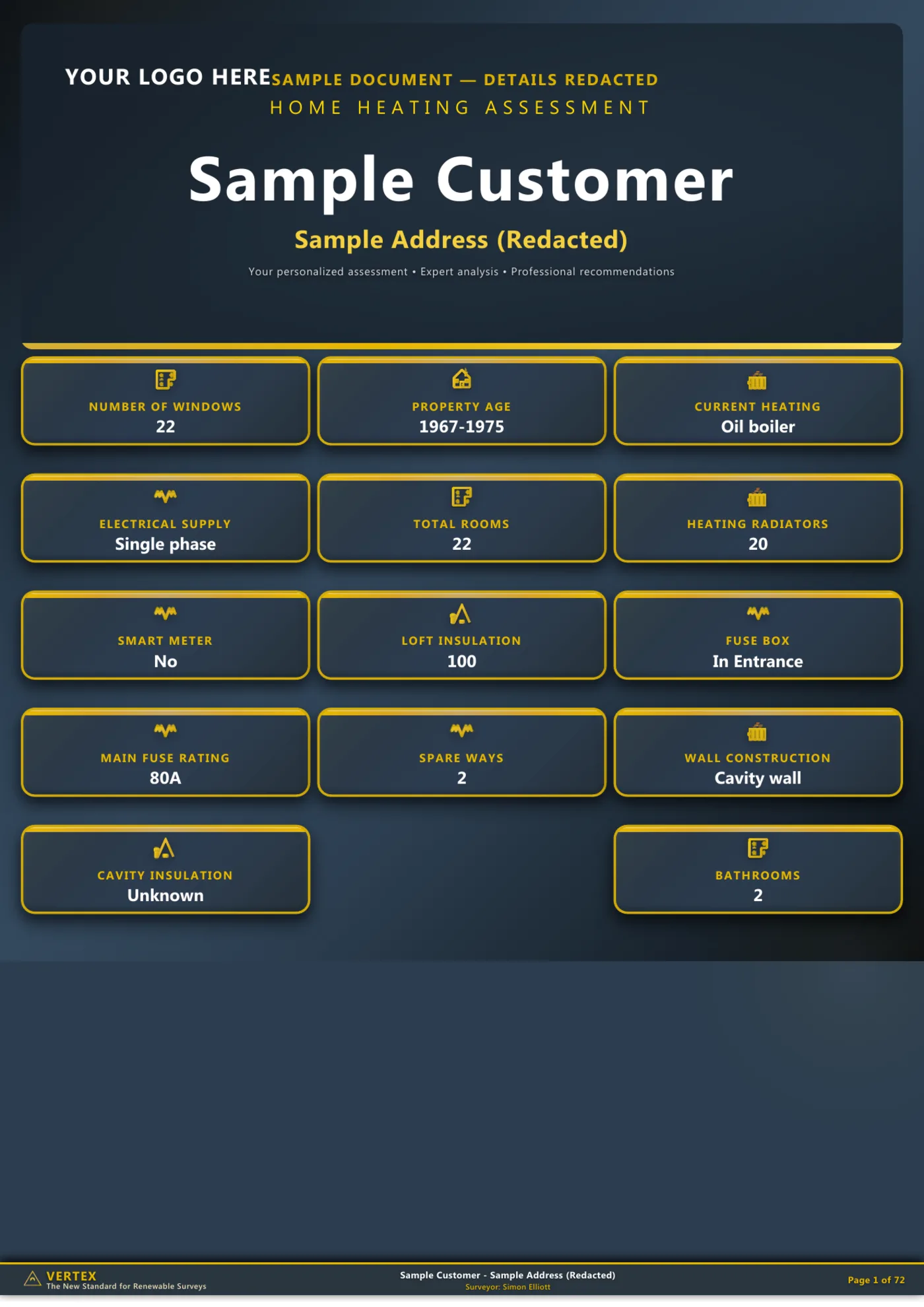
The finished PDF is structured around decisions, not upload order. Installer teams can inspect the current sample before they send a live job.
Installer teams should not need a different survey standard in every sales area. Vertex gives you one route across England, Scotland, Wales and Northern Ireland, with the postcode, scope and lead time checked before booking.
Use one renewable survey company for national installer coverage, instead of stitching together local surveyors with different report styles.
Check the sample report, pricing route, portal delivery and public Trustpilot profile before you send live jobs into the diary.
ASHP, GSHP, solar PV, solar design, battery, EPC and heat loss evidence can be handled through one consistent operating model.
The point is not to produce another document. The point is to give the office, designer, and installer enough site detail to move the job without avoidable callbacks.
ASHP and GSHP survey routes with siting, access, electrical, plant, heat loss, and report evidence for installer teams.
Roof, shading, access, electrical, inverter, cable-route, and battery-ready detail before layout and design decisions harden.
Room-by-room evidence, visible assumptions, desktop routes where information is strong, and measured survey routes where it is not.
Battery location, access, existing electrical context, retrofit constraints, and report notes where storage is part of the opportunity.
Roof layout context, inverter position, cable routes, battery context and DNO-ready evidence where the installer needs the survey record to support design work.
EPC position, assessment route and supporting property evidence can sit alongside the wider renewable survey record where included in the booked scope.
A strong renewable survey report should be more than attendance proof. It should give the installer, designer and office team the evidence they need to price, design and plan the job.
Outdoor unit siting, boundary context, access, service space and sound-input notes are recorded where the ASHP survey scope needs them.
Room measurements, emitter notes, floor-plan context and fabric assumptions can support heat loss review and heat-pump design checks.
Roof planes, shading, access, consumer unit context, likely inverter position and cable-route evidence help the solar design move from guesswork to visible site facts.
Meter position, cut-out, consumer unit, spare ways, phase context and obvious quote-changing constraints are grouped for the team reviewing the job.
The job record and finished PDF report are delivered through the portal so teams are not piecing together loose photos, emails and notes.
Report sections, labelled photos, measurements, assumptions and unresolved constraints are reviewed before the file is treated as ready for the next step.
A renewable energy survey company should make the next step easier. If the report still leaves the team guessing, the visit has not done its job.
Teams do not have to relearn the document on every job. The same sections, labels, and final checks make the report faster to review.
Photos, notes, measurements, and constraints sit near the decision they support, instead of being left as a loose file dump.
The report is built so the team quoting, the team designing, and the team fitting can work from the same facts.
Bookings, evidence, downloads and report handover sit in one route, so the office is not chasing scattered files after every survey.
Vertex provides survey-only support. We do not sell or install heat pumps, solar panels or batteries, so the report is built for your installer process.
Sample reports, case studies, public pricing and verified Trustpilot feedback give your team proof before the first live job is booked.
Confirmed ASHP jobs with MCS 020(a), siting, access, electrical, and report-detail questions.
The main solar route for roof, access, electrical, battery-ready, pricing, and booking detail.
PV design support, roof layout constraints, inverter context, and cable-route evidence.
Solar design support where roof evidence, DNO context, inverter route and battery-ready notes need to be visible.
Measured or desktop heat loss routes for room-by-room outputs and visible assumptions.
Attendance is the start of the job. A good survey company captures the evidence that keeps quoting, design and installation moving without avoidable follow-up.
The fastest way to judge a renewable survey provider is to inspect the output. The sample should show section order, photo handling, measurements, assumptions, and QA checks.
Installer teams need to know exactly what is included before the diary moves. ASHP, GSHP, solar PV, battery, EPC, and heat loss work each need different evidence.
The report needs to land consistently whether you send one test job or steady monthly volume. That means predictable labels, predictable QA, and a clear delivery route.
These are the routes most installer teams compare when they are choosing who should capture the site evidence.
Use this route for ASHP, GSHP, siting, access, plant, electrical, heat loss, and quote-ready evidence before the system design hardens.
Use this route for roof context, shading, access, inverter position, cable route, electrical intake, DNO-ready context, and battery-ready evidence.
Use this route for room-by-room inputs, measured or desktop heat loss calculations, clear assumptions, and design-reviewable outputs.
Use the installer page when you want the wider operating model, pricing builder, sample report, public reviews, and portal delivery route in one place.
It captures the site evidence installer teams need before quote, design, and installation. That can include heat pump, solar PV, battery storage, EPC, and heat loss survey evidence.
Yes. The main commercial routes are heat pump surveys, solar PV surveys, battery storage surveys, EPC evidence, and heat loss survey or calculation routes.
The process is built around installer teams, although homeowners can start a route when they need survey evidence before choosing an installer.
Start with the sample report, pricing, turnaround, QA checks, survey scope, and whether the final report can be used by office, design, and installation teams without extra chasing.
Yes. Vertex provides full UK renewable survey coverage across England, Scotland, Wales and Northern Ireland, with postcode, scope, travel route and lead time confirmed before booking.
Yes. The report route is built around portal delivery and PDF handover, so the office, designer and install team can work from one organised job record.